What Is Good Financial Advice Actually Worth? A 2026 Study Puts a Number on It
If you run a business or earn a high income, you have probably asked yourself some version of this question: "I am smart, I am disciplined, and I can buy an index fund on my phone in ten seconds. What exactly would a financial advisor do for me that I cannot do myself?"
It is a fair question. It is also the right question. You should be skeptical about what you pay for.
Russell Investments recently published its 2026 Value of an Advisor Study, and Forbes covered the findings in July. The study has been running for thirteen years, and it tries to answer that exact question with a number instead of a sales pitch.
The number they landed on is 4.92% per year.
That is the estimated annual value the average financial advisor adds to a client's outcome. Not from picking better stocks. From four specific things that have very little to do with predicting the market.
Let me walk you through what those four things are, and more importantly, what each one actually looks like in the life of someone earning $250,000 or more, or sitting on $500,000 or more in investable assets. Because the value is not evenly distributed. Some of these matter enormously for you and barely at all for someone just starting out.
First, an honest caveat
A study is a study. It uses averages, assumptions, and modeled scenarios. Your results will not be 4.92%. They might be more. They might be less. Nobody can promise you a number, and you should walk away from anyone who does.
What the study does well is something different and more useful. It identifies where the value comes from. Once you know that, you can evaluate any advisor, including me, on whether they actually deliver those things or just talk about them.
So think of the four categories below less as a price tag and more as a checklist.
The four sources of value: A, B, C, and T
The study breaks advisor value into four pillars:
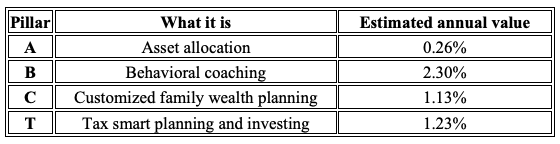
Notice what is missing. There is no line item for "beat the market." That is not an oversight. It is the entire point.
Notice something else. The smallest number, by far, is the one most people think they are paying for. Picking the portfolio is worth about a quarter of a percent. Managing the human being who owns the portfolio is worth nearly ten times that.
Let's take them in order of how much they probably matter to you.
B: Behavioral coaching, worth an estimated 2.30% a year
This is the big one, and it is the one people resist hardest.
Here is the uncomfortable truth: the more successful you are, the more dangerous your instincts become. The traits that built your business, decisiveness, conviction, a willingness to act fast when you see an opportunity, are the exact traits that destroy portfolios.
You did not get where you are by sitting still. So when the market drops 25% and your account is down $400,000 in six weeks, sitting still feels like negligence. It feels like the one time you should trust your gut.
The study points to March 2020 as the case study. Investors pulled roughly $330 billion out of the market during the pandemic selloff. The market then rebounded 63%. Every dollar that left missed it.
Those were not foolish people. Many of them were sophisticated, experienced investors who had lived through 2008 and told themselves they had learned the lesson. Under enough pressure, everybody's discipline has a breaking point.
What this looks like for you specifically:
When your portfolio is $200,000, a bad 10% week costs you $20,000. Painful, survivable, and honestly not enough to trigger a truly reckless decision.
When your portfolio is $2 million, that same week costs you $200,000. That is a house down payment evaporating while you eat breakfast. The math has not changed at all. The emotional weight has changed completely.
And if you own a business, you carry a second layer of risk that most articles ignore. Your income, your net worth, and often your building or your equity are all tied to the same economy. When the market falls, it usually falls at the same time your revenue softens and your clients get slow to pay. You feel the squeeze from three directions at once, and that is precisely the moment you are most likely to make a permanent decision about a temporary problem.
A good advisor is not there to predict the drop. A good advisor is there so that when the drop comes, the decision was already made, in writing, back when you were calm.
T: Tax smart planning, worth an estimated 1.23% a year
For most high earners, taxes are the single largest lifetime expense. Larger than the mortgage. Larger than college. Larger than everything.
And here is where a lot of successful people are quietly leaving money on the table without knowing it, because their CPA and their investment account are not talking to each other.
Your CPA is excellent at what they do. But most CPAs are backward looking by design. They report what already happened, accurately and on time. That is the job. Forward looking tax positioning, deciding in March what you should do in November, is a different function, and it often falls into a gap where nobody owns it.
The study estimates that tax aware investment management alone is worth about 1.23% a year. That comes from things like:
Asset location. Not which investments you own, but which account you own them in. Bonds and other income producing assets generally belong in tax deferred accounts. Long term growth and tax efficient holdings generally belong in taxable accounts. Same portfolio, same risk, different tax bill.
Tax loss harvesting. Selling positions that are down to bank the loss, staying invested the whole time, and using those losses to offset gains elsewhere. This is especially valuable in a year you sell a building, exercise options, or exit a business.
Direct indexing. Instead of owning an index fund, you own the underlying stocks directly. You track the index closely, but you can harvest losses on individual positions inside it. It also gives you a way to unwind a concentrated position over time without a single enormous tax event.
Distribution sequencing. Which account you pull from first in retirement, and in what order, can change your lifetime tax bill by a meaningful amount. This decision gets made once, and it echoes for thirty years.
The study offers a simple illustration: on a $1 million portfolio, a tax aware approach can cut the drag from taxes from around 2.1% down to roughly 0.1%. Repeat that annually for two decades and it compounds into real money.
A note for business owners: the biggest tax planning opportunity in your life is usually not in your investment account at all. It is in your entity structure, your retirement plan design, and how you eventually sell. A solo 401(k), a cash balance plan, or a defined benefit plan can let a profitable owner shelter far more than a standard 401(k) allows. If you are writing large checks to the IRS every April and your only retirement account is a SEP IRA, that is worth a conversation this year, not next year.
C: Customized family wealth planning, worth an estimated 1.13% a year
At a certain level of wealth, the complexity stops being about investments and starts being about coordination.
You have a business. You have real estate. You have a 401(k) from a job you left in 2014. Your spouse has equity comp with a vesting schedule nobody has mapped. You have a will from before your second child was born. You have an insurance policy your uncle sold you in 2009 that may or may not still make sense. Your parents are aging and nobody has asked the hard questions yet.
None of those pieces are wrong on their own. The problem is that there is no plan connecting them, and nobody whose job it is to look at the whole board.
That is the role the study is describing when it talks about customized planning. Some people call it being the family CFO. It means one person who understands how your business succession plan interacts with your estate plan, how your charitable giving interacts with your tax plan, and how a decision you make about your building affects your retirement income twelve years from now.
For families with children, grandchildren, or a business that will change hands, this is often where the largest dollar amounts actually live. Estate mistakes and succession mistakes are usually much more expensive than investment mistakes, and they are far harder to correct after the fact.
A: Asset allocation, worth an estimated 0.26% a year
Last on the list, and smallest, which surprises people.
The study found that self directed investors tend to hold about 20% of their portfolio in cash. Not by strategy. By accumulation and hesitation. Money comes in, it sits, and the right moment to invest it never quite arrives.
That habit is understandable, and it is expensive. Over the twenty year period the study examined, advisor built portfolios returned about 6.98% annualized compared to about 6.45% for self directed portfolios. The advisor portfolios were also more diversified across international equities and other asset classes, which in practice means a less bumpy ride.
The smoother ride matters more than the extra half percent, because the smoother ride is what makes it possible for you to actually stay invested. Which loops right back to pillar B.
The part nobody is talking about yet: the advisor shortage
One more finding from the study that deserves your attention.
Roughly 40% of financial advisors, managing about 42% of industry assets, are expected to retire in the next decade.
If you already work with an advisor, there is a real chance yours is in that group. That transition is not automatic. Your relationship, your history, and your institutional knowledge do not necessarily transfer to whoever buys the practice.
If your advisor is nearing retirement, ask them directly what their succession plan is. Ask who would take over your account and whether you have met that person. A good advisor will have a clear answer and will respect you for asking.
And if you are currently unadvised and planning to "get around to it," understand that the pool of experienced advisors taking on new clients is going to shrink, not grow.
How to evaluate an advisor using this framework
Here is the practical takeaway. When you meet with any advisor, use the four pillars as your interview guide.
On behavior: "What specifically will you do the next time the market drops 30%? Walk me through what you did in 2020 and 2022."
On taxes: "Do you coordinate with my CPA? Do you review my actual tax return? Give me an example of a tax strategy you implemented for a client like me in the past year."
On planning: "What does your planning cover beyond investments? Estate, insurance, business succession, equity compensation?"
On allocation: "How do you build a portfolio and why? What do you charge, and what is the all in cost including fund expenses?"
Then ask two more:
"Are you a fiduciary, in writing, all the time?" Not sometimes. Not on certain accounts. Get it in writing.
"What are your credentials?" The CFP® mark means the person completed the coursework, passed a comprehensive exam, met an experience requirement, and committed to a code of ethics. It is not a guarantee of anything, but it does tell you the person invested years in learning the whole picture rather than just the product they sell.
The real bottom line
The 4.92% is a useful headline. I would not build a decision around it.
Here is what I would build a decision around. Roughly three quarters of the value in that study comes from behavior, taxes, and planning. Only a sliver comes from portfolio construction.
That means the question is not "can this person pick better investments than me?" The answer for almost everyone, including professional advisors, is no, not reliably.
The question is: do I have a plan that connects everything, a tax strategy that looks forward instead of backward, and someone in my corner who will stop me from making a permanent mistake on my worst day?
If you can answer yes to all three on your own, you may not need an advisor. Some people genuinely do not, and I will tell you that honestly if it is true for you.
If you cannot answer yes, that gap is not a small one. It compounds, quietly, every single year.
Let's find out what your gap is
I work with business owners, executives, and professionals who have built real wealth and want to be sure it is being managed with the same intention they used to build it.
The first conversation is a discovery meeting. No products, no pitch, no pressure. We talk about your family, your business, your goals, and what you actually have in place today. You will leave with a clearer picture of where you stand whether or not we ever work together.
If that sounds useful, reach out.
Argenis David Biscardi, CFP®, ChFC®, WMCP®, MS Certified Financial Planner™ | Fee Based Financial Advisor | Fiduciary Pacific Financial Partners 3703 Mt. Diablo Blvd., Lafayette, CA 94549 Phone and text: (925) 298-5269 Email: abiscardi@pacificfp.com
Disclosures
Securities and investment advisory services offered through Osaic Wealth, Inc., member FINRA/SIPC. Osaic Wealth is separately owned and other entities and/or marketing names, products or services referenced here are independent of Osaic Wealth. CA License # 0M79216.
The figures referenced in this article come from the 2026 Value of an Advisor Study published by Russell Investments and reporting by Forbes. Russell Investments is not affiliated with Osaic Wealth or Pacific Financial Partners. The estimated value figures are hypothetical, based on the study's assumptions and methodology, and are not a guarantee, projection, or promise of any particular result. Individual results will vary.
This material is for informational and educational purposes only and does not constitute individualized investment, tax, or legal advice. Investing involves risk including the potential loss of principal. Diversification and asset allocation do not ensure a profit or protect against loss in a declining market. Past performance does not guarantee future results. Tax loss harvesting and direct indexing strategies have limitations and may not be appropriate for all investors. Please consult your tax professional or attorney regarding your specific situation. Portfolio and/or account monitoring apply to fee based advisory services only.