Estimated reading time: 8 minutes
You have put years into your business. Long days, tough decisions, payroll you covered before you paid yourself. And somewhere in the back of your mind, there is a finish line. Maybe you want to sell and retire. Maybe you want to hand the keys to someone else and start your next chapter.
When that day comes, one question will matter more than almost any other:
How much of the sale price do you actually get to keep?
For many owners, one of the largest checks written at closing goes to taxes. But there is a part of the tax code, Section 1202, that may allow some business owners to exclude a large portion of their gain from federal tax when they sell. In some cases, all of it.
The catch? It only works if the business is set up the right way, and the clock has to start years before the sale. That is why this is a conversation to have now, not when a buyer shows up.
Let's walk through it in plain English.
What Is QSBS?
QSBS stands for Qualified Small Business Stock. It is defined in Section 1202 of the Internal Revenue Code.
Here is the simple version. If you own stock in a qualifying small C corporation, you received that stock directly from the company, and you hold it long enough, you may be able to exclude some or all of your gain from federal income tax when you sell.
Congress created this rule to reward people who build and invest in small American businesses. For the right owner, it can be one of the most valuable tax benefits available.
What Changed in 2025
In July 2025, the One Big Beautiful Bill Act made QSBS more generous for stock issued after July 4, 2025. Here is a side by side look:
Stock issued before July 5, 2025Stock issued after July 4, 2025Holding period5 years for 100% exclusion3 years: 50% excluded
4 years: 75% excluded
5 years: 100% excludedMaximum gain excluded per companyGreater of $10 million or 10x your basisGreater of $15 million or 10x your basis (adjusted for inflation starting in 2027)Company size limit (gross assets)$50 million$75 million (adjusted for inflation starting in 2027)
Three things stand out for business owners:
More flexibility on timing. Before, if you sold even one day short of five years, you generally lost the benefit. Now there is a partial benefit starting at year three.
A bigger exclusion. Up to $15 million of gain per person, per company, or more if your basis is high.
Room to grow. Companies can be larger and still qualify.
Does Your Business Qualify?
This is where the details matter. Here are the main requirements, simplified:
✓ It must be a C corporation. LLCs, S corporations, partnerships, and sole proprietorships do not issue QSBS.
✓ You must get the stock directly from the company. Stock you received when the company was formed, or in exchange for money, property, or services, can qualify. Stock you bought from another shareholder generally does not.
✓ The company must be "small" when the stock is issued. Gross assets of $75 million or less, before and immediately after the stock is issued.
✓ The business must be active. At least 80% of the company's assets must be used in running a qualifying business. A company that is mostly holding cash or investments may not pass.
✓ The industry must qualify. This is the one that surprises people. Many service businesses are excluded, including:
Health and medical practices
Law, accounting, and actuarial firms
Engineering and architecture
Consulting, financial services, and brokerage
Performing arts and athletics
Banking, insurance, financing, and investing
Farming, and certain oil, gas, and mining businesses
Hotels, motels, and restaurants
Any business where the main asset is the reputation or skill of its people
Businesses that often qualify include technology, software, manufacturing, distribution, wholesale, retail, and many product based companies. Every situation is different, so the industry question should always be reviewed by a tax professional.
A note for professionals: If you are a physician, attorney, or consultant, your own practice likely will not qualify. But if you invest in early stage companies as an angel investor, those shares might. It is worth asking the question.
The Hidden Problem for Many Owners: Your Entity Type
Most small and mid sized businesses are set up as LLCs or S corporations. There are good reasons for that. These structures avoid double taxation and keep things simple.
But here is the issue. QSBS only comes from C corporation stock. If your business is an LLC or S corporation today, your current ownership does not count toward QSBS.
To use Section 1202, you would generally need to restructure into a C corporation. When that happens:
The holding period clock starts on the date the C corporation stock is issued, not the date you started the business.
The growth that happened before the conversion is not covered. Only the gain after conversion may be eligible for the exclusion.
Your tax picture changes. C corporations pay corporate income tax (currently 21% federally), and profits you take out as dividends are taxed again. That trade off has to be weighed against the potential benefit at sale.
Converting is not right for everyone. But for a growing company with a likely sale on the horizon, it can be worth a serious look. And the sooner the clock starts, the sooner the benefit becomes available.
Why 3 to 5 Years of Planning Makes the Difference
Let's look at a hypothetical example to see why timing matters so much.
Maria owns a software company. She restructures into a C corporation, and her shares meet the QSBS requirements. Years later, she sells and has a $12 million gain on her qualifying stock.
Here is a simplified estimate of her federal tax on that gain, depending on when she sells:
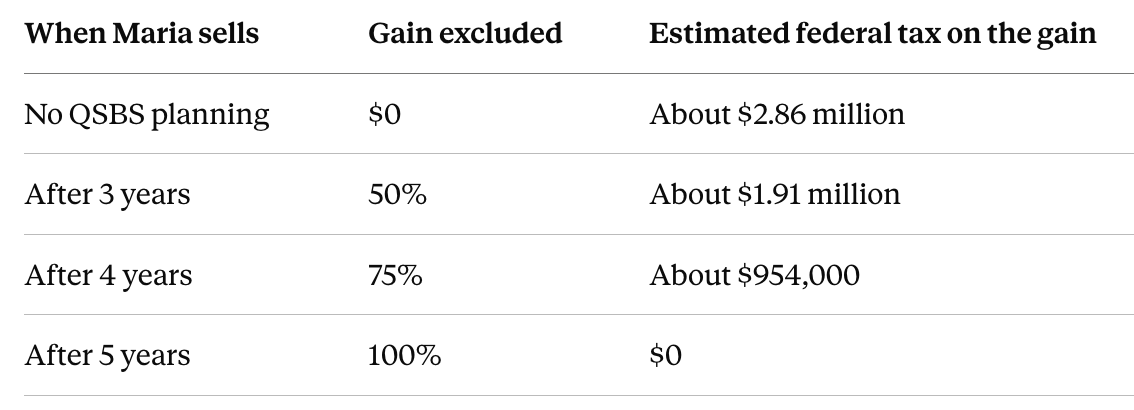
This is a hypothetical example for illustration only. It assumes the gain is taxed at a 20% long term capital gains rate plus the 3.8% net investment income tax, and that the portion of gain not excluded under Section 1202 is taxed at 28% plus 3.8%. It does not reflect any actual client, and it does not include state taxes. Your results will be different.
Look at the gap between selling in year three and year five. In this example, waiting two more years could mean keeping close to $1.9 million more of her own money.
That is the power of starting early. If you think you may sell in five years, the best time to start planning is today. If you think you may sell in three years, you may still be able to capture part of the benefit, but the window is closing.
A Big Note for California Business Owners
If you live in California, there is something important to know. California does not follow Section 1202. Even if your gain is fully excluded from federal tax, California may still tax the entire gain at its normal rates, which go as high as 13.3%.
That does not make QSBS worthless here. Saving federal tax can still be meaningful. But it does mean your plan should include an honest look at the full after tax result. Some owners also consider the state rules around residency or trust planning, and these strategies come with strict rules and real audit risk. This is not something to do on your own.
Other Strategies Your Team May Discuss
Once QSBS is on the table, your advisors may bring up a few related ideas:
Stock sale vs. asset sale. QSBS generally applies when you sell your stock. Many buyers prefer to buy assets instead. How the deal is structured can make or break the benefit, so this should be part of negotiations from the start.
Gifting shares to family. Each person has their own exclusion limit. Shares gifted to children or certain types of trusts generally keep their QSBS status. With careful planning, a family may be able to multiply the total amount of gain that can be excluded. This works best when done well before a sale.
Rolling over gains (Section 1045). If you sell QSBS before meeting the holding period, you may be able to reinvest the proceeds into another qualifying small business within 60 days and defer the gain.
Each of these has rules, costs, and risks. They are tools, not shortcuts.
Building Your Exit Team
Selling a business is not a one person job. Getting QSBS right takes a team of specialists working together. Here is who usually belongs at the table:
CPA or tax advisor. Reviews whether your business qualifies, models the tax trade offs of becoming a C corporation, and keeps the records that prove eligibility.
Corporate or tax attorney. Handles the legal side of restructuring, drafts documents, and makes sure the stock is issued correctly.
Estate planning attorney. Sets up trusts and gifting strategies if you plan to share the benefit with your family.
M&A advisor or business broker. Helps you find buyers, value the business, and negotiate deal terms, including whether it is a stock or asset sale.
Valuation professional. Documents what the business is worth at key moments, such as when you convert. This supports your numbers if they are ever questioned.
CFP® professional. This is where I come in.
Where a CFP® Professional Fits In
Think of a CFP® professional as the general contractor of your financial life. The CPA, attorney, and M&A advisor are all experts in their own areas. My job is to make sure every piece fits together into one plan built around your goals.
Here is what that looks like in practice:
Starting with your "why." How much do you need from the sale to retire comfortably? What do you want to leave to your family? Those answers shape every decision that follows.
Mapping the timeline. Working backward from your target sale date so the QSBS clock, the restructuring, and the gifting strategies all happen in the right order.
Coordinating your team. Making sure your CPA, attorney, and other advisors are working from the same playbook and nothing falls through the cracks.
Modeling the outcomes. Showing you what life could look like after the sale under different scenarios, so you can make decisions with clear eyes.
Planning for the day after. A liquidity event can be the largest financial moment of your life. What happens to that money once the sale closes? Investing it wisely, creating retirement income, managing taxes year after year, and protecting your family's future is where long term wealth is truly built.
The goal is simple: turn the success you built into wealth that lasts for generations.
Questions to Ask Yourself Today
Not sure where you stand? Start with these:
Could I see myself selling my business in the next 3 to 10 years?
Is my business a C corporation, an S corporation, or an LLC?
Is my industry likely to qualify under Section 1202?
Has my CPA ever brought up QSBS with me?
Do I know how much I need from a sale to retire on my terms?
Do I have a team of advisors who talk to each other?
If you answered "I'm not sure" to any of these, that is completely normal. Most business owners have never been asked these questions. But they are worth answering while you still have time to act.
Let's Start the Conversation
The owners who get the best results from a sale are almost always the ones who planned for it years in advance. The rules reward preparation. Waiting until a buyer makes an offer is often too late to take full advantage.
If you are thinking about selling your business someday, I'd welcome the chance to learn about your goals. In a no obligation discovery meeting, we will talk about where you are today, where you want to go, and whether strategies like QSBS may be worth exploring with your tax and legal advisors.
Argenis David Biscardi, CFP®, MS | Pacific Financial Partners 3703 Mt. Diablo Blvd., Lafayette, CA 94549 Phone or text: (925) 298-5269 Email: abiscardi@pacificfp.com